Every little thing You Need to Understand About the L1 copyright: Benefits, Requirements, and More
The L1 copyright works as a critical tool for multinational companies looking for to transfer employees to the United States, facilitating both functional effectiveness and the transfer of specialized expertise. With unique categories for executives and specialized professionals, this copyright presents many advantages, consisting of possible paths to irreversible residency. Understanding the eligibility needs and application process is crucial for a successful change. As we analyze the ins and outs of the L1 copyright, it comes to be clear that maneuvering its complexities is vital for organizations aiming to utilize international ability efficiently. What difficulties might you come across along the way?
Review of the L1 copyright
The L1 copyright is a non-immigrant classification that permits firms to transfer employees from international offices to their united state branches, subsidiaries, or associates. This copyright category is specifically useful for international companies looking for to utilize their international talent pool by relocating key workers to enhance procedures in the USA. The L1 copyright is split right into two primary subcategories: L1A for managers and executives, and L1B for employees with specialized knowledge, each catering to various organizational needs.The L1 copyright promotes the smooth movement of certified staff members, therefore cultivating global service growth and functional performance. With the L1A copyright, firms can transfer people that hold managerial or executive roles, allowing them to make tactical choices and look after details divisions within the united state entity. On the other hand, the L1B copyright is developed for employees having specialized understanding important to the firm's rate of interests, ensuring that the U.S. workplace advantages from unique skills and expertise.One noteworthy benefit of the L1 copyright is its twin intent nature, which permits holders to make an application for long-term residency while preserving their non-immigrant standing. Furthermore, spouses and youngsters of L1 copyright holders can accompany them to the USA under the L2 copyright classification, which also permits for work consent
Kinds Of L1 Visas
Numerous kinds of L1 visas satisfy the varied needs of international business wanting to move workers to the USA. Both key classifications of L1 visas are L1A and L1B, each made for specific roles and obligations within an organization.The L1A copyright is intended for managers and execs. This category enables firms to transfer individuals that hold supervisory or executive settings, enabling them to supervise procedures in the united state. This copyright is legitimate for an initial period of as much as 3 years, with the opportunity of extensions for an overall of up to seven years. The L1A copyright is specifically valuable for companies seeking to develop a strong leadership presence in the U.S. market.On the other hand, the L1B copyright is designated for employees with specialized knowledge. This consists of individuals who possess sophisticated know-how in specific areas, such as proprietary innovations or one-of-a-kind procedures within the firm. The L1B copyright is also valid for an initial three-year period, with extensions available for up to five years. This copyright category is perfect for business that need workers with specialized skills to improve their operations and preserve an one-upmanship in the U. L1 copyright.S.Both L1A and L1B visas permit for twin intent, meaning that copyright holders can apply for irreversible residency while on the copyright. Understanding the distinctions in between these two classifications is crucial for businesses planning to navigate the intricacies of staff member transfers to the USA properly
Eligibility Requirements
To receive an L1 copyright, both the employer and the worker have to fulfill specific eligibility criteria set by U.S. immigration authorities. The L1 copyright is developed for intra-company transferees, enabling multinational companies to move staff members to their united state offices.First, the company needs to be a certifying company, which indicates it needs to have a moms and dad firm, branch, subsidiary, or associate that is doing service both in the united state and in the international nation. This connection is necessary for showing that the worker is being transferred within the same business structure. The employer must additionally have actually been doing organization for at the very least one year in both locations.Second, the worker needs to have been employed by the foreign firm for at least one continuous year within the 3 years preceding the application. This work should be in a supervisory, exec, or specialized expertise capability. For L1A visas, which deal with managers and execs, the worker should show that they will certainly remain to run in a comparable capacity in the united state For L1B visas, meant for workers with specialized knowledge, the individual need to have unique knowledge that contributes significantly to the firm's operations.
Application Process
Steering the application procedure for an L1 copyright involves a number of vital steps that must be finished accurately to guarantee an effective result. The initial step is to figure out the ideal group of the L1 copyright: L1A for managers and executives, or L1B for staff members with specialized expertise (L1 copyright). This difference is substantial, as it affects the paperwork required.Once the group is determined, the united state employer need to file Kind I-129, Request for a Nonimmigrant Worker. This kind should consist of in-depth details regarding the company, the worker's function, and the nature of the work to be done in the united state Accompanying paperwork commonly includes evidence of the connection in between the united state and international entities, evidence of the staff member's qualifications, and details pertaining to the task offer.After submission, the united state Citizenship and Immigration Services (USCIS) will certainly assess the request. If accepted, the employee will certainly be alerted, and they can then make an application for the copyright at an U.S. consulate or consular office in their home nation. This involves completing Kind DS-160, the Online Nonimmigrant copyright, and setting up an interview.During the meeting, the applicant must present numerous records, including the approved Type I-129, evidence of work, and any extra supporting proof. Complying with the interview, if the copyright is approved, the staff member will obtain a copyright stamp in their copyright, enabling them to enter the U.S. to benefit the sponsoring company. Appropriate prep work and detailed paperwork are essential to navigating this procedure efficiently
Advantages of the L1 copyright
One of the notable advantages of the L1 copyright is its capability to facilitate the transfer of key employees from international offices to the United States. This copyright is particularly valuable for multinational business seeking to preserve uniformity in procedures L1 copyright and leadership throughout boundaries. By enabling execs, managers, and specialized employees to function in the united state, companies can ensure that their most necessary skill is offered to drive organization objectives.Another substantial benefit of the L1 copyright is its relatively simple application procedure compared to other job visas. Organizations can seek for the L1 copyright without the need for a labor accreditation, which streamlines the employment of foreign staff members. In addition, the copyright can be approved for a first period of up to three years, with the opportunity of extensions, facilitating long-lasting assignments.The L1 copyright likewise provides a course to irreversible residency. Workers on L1A visas (for managers and execs) can make an application for a Permit after one year, quickening their modification to long-term standing. This function is an eye-catching reward for skilled individuals searching for stability in the U.S. workforce.Additionally, L1 copyright owners can bring their instant member of the family to the U.S. under L2 condition, allowing spouses and youngsters to live and research in the country, improving the overall charm of this copyright category. Generally, the L1 copyright acts as an essential tool for worldwide organizations, cultivating cross-border partnership and skill wheelchair.
Common Difficulties
While the L1 copyright provides various benefits for multinational companies and their employees, it is not without its difficulties. One significant hurdle is the rigid documentation and qualification needs enforced by the U.S. Citizenship and Migration Provider (USCIS) Companies must give thorough proof of the international employee's qualifications, the nature of business, and the certifying relationship in between the U.S. and international entities. This process can be time-consuming and might need lawful proficiency to navigate successfully.Another challenge is the potential for scrutiny during the petition procedure. USCIS officers may examine the authenticity of the company operations or the staff member's duty within the company. This examination can bring about delays or even rejections of the copyright, which can substantially impact the business's functional strategies and the employee's occupation trajectory.Furthermore, the L1 copyright is linked to the sponsoring company, which means that work adjustments can complicate the copyright standing. If an L1 copyright holder wants to switch over employers, they have to usually go after a different copyright category, which can include intricacy to their immigration journey.Lastly, keeping conformity with L1 copyright regulations is essential. Employers must guarantee that their employee's function aligns with the initial application which the service remains to fulfill the qualification needs. Failing to do so can result in cancellation of the copyright, affecting both the staff member and the company. These challenges demand comprehensive prep work and ongoing monitoring to guarantee a successful L1 copyright experience.
Tips for Success

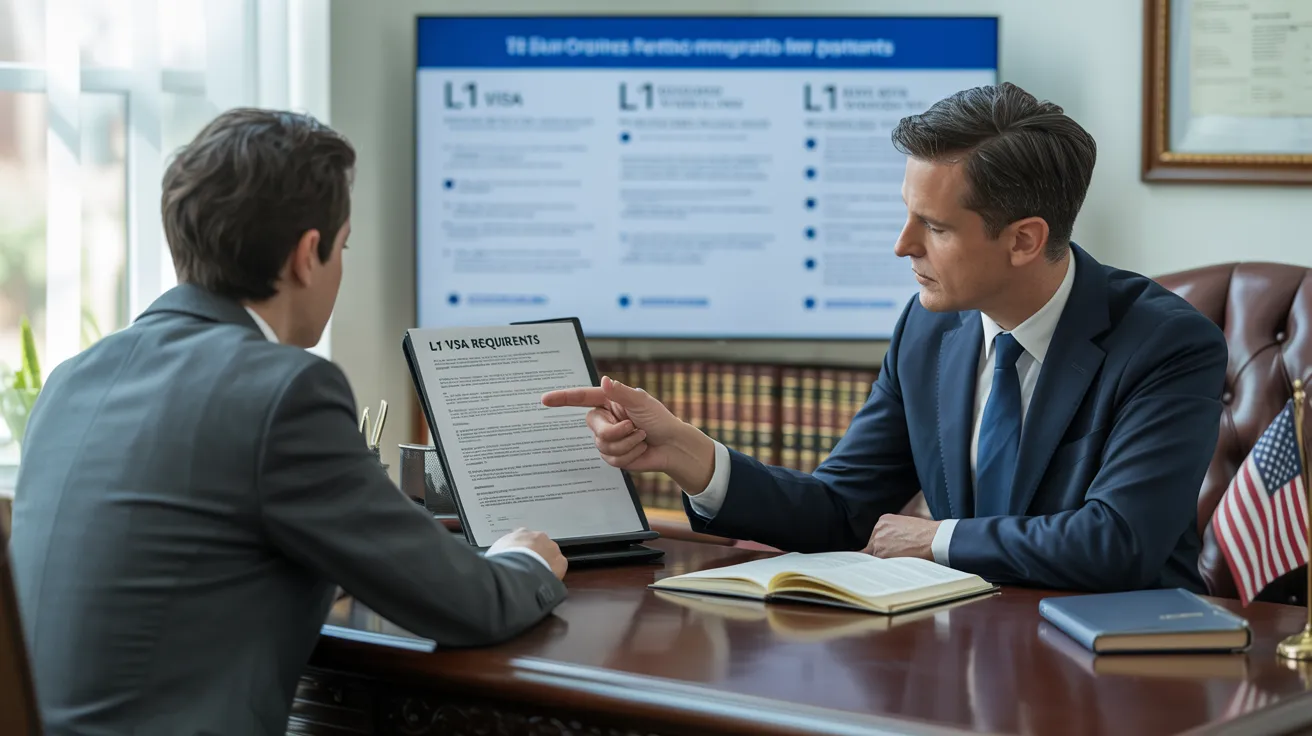
To efficiently browse the L1 copyright process, careful preparation is vital. Start by extensively understanding the certain needs for the L1 copyright category you are making an application for, whether L1A for supervisors and executives or L1B for employees with specialized expertise. Gather all needed paperwork early at the same time, including evidence of your employment background, business framework, and the nature of the company operations.Engage lawful counsel experienced in migration law to direct you via the details of the application. A lawyer can aid assure that your application is full, precise, and compelling. They can likewise assist in getting ready for potential ask for proof (RFEs) by proactively attending to areas that might increase questions.Additionally, preserve clear communication with your employer, that should give essential support for your application. Confirm that they understand their responsibilities, including submitting the required requests and offering paperwork that confirms your function in the organization.Prepare for the copyright interview by practicing response to typical inquiries regarding your expert background and the nature of your work. Demonstrating confidence and clarity can substantially impact the result of your application.
Often Asked Concerns
Can Family Members Accompany L1 copyright Owners?
Yes, household members can accompany L1 copyright owners. Partners and unmarried kids under 21 years of ages are eligible for L2 visas, which allow them to live and examine in the USA during the L1 holder's stay.
How Much Time Can L1 copyright Owners Remain In the united state?
L1 copyright owners can originally remain in the united state for approximately three years. This period may be extended, enabling a maximum stay of seven years for L1A copyright holders and 5 years for L1B copyright owners
Is the L1 copyright a Double Intent copyright?
The L1 copyright is thought about a twin intent copyright, allowing owners to go after long-term residency while preserving their short-lived non-immigrant condition. This versatility helps with long-lasting career opportunities for global staff members within united state companies.
Can L1 copyright Owners Look For a Permit?
Yes, L1 copyright holders can request a permit (L1 copyright Requirements). The L1 copyright sustains dual intent, enabling holders to go after irreversible residency while maintaining their non-immigrant standing, facilitating a smoother changeover to a copyright
What Happens if an L1 copyright Is Rejected?
If an L1 copyright is denied, the candidate might receive a notice detailing the factors for denial. They can appeal the choice, reapply, or check out alternate copyright choices relying on their scenarios and certifications.
Final thought
In summary, the L1 copyright serves as an essential tool for international firms looking for to transfer employees to the United States. Recognizing the distinctions between L1A and L1B categories, in addition to the qualification requirements and application processes, is essential for successful navigation of this non-immigrant category. The advantages offered, consisting of streamlined applications and paths to permanent residency, even more boost its appeal. L1 copyright Requirements. Addressing common difficulties successfully can cause a much more beneficial outcome in the copyright process